
7% Rule in Real Estate: What Property Investors and Home Sellers Should Know About Land Investment and Property Returns
March 16, 2026
By David Singh Roy
Introduction
The 7% rule in real estate is one of the simplest ways property investors quickly evaluate whether a deal is financially worth pursuing. Instead of spending hours analyzing every property, investors use this rule as a fast screening tool to estimate whether a property has the potential to produce strong returns.
But the concept isn’t just useful for investors. It can also help homeowners who are asking an important question: Should I keep my property as an investment, or should I sell my house?
For many homeowners in Queens, New York and Long Island, rising property values make this decision even more complicated. A property might look valuable on paper, but that doesn’t always mean it performs well as an investment.
Understanding how the 7% rule works can help clarify whether a property is functioning like a true investment or whether selling and reinvesting the equity might be the smarter financial move
Featured Topics
What Is the 7% Rule in Real Estate?
The 7% rule in real estate is a quick investment screening formula used by property investors to estimate whether a property can generate strong annual returns relative to its purchase price.

This formula gives investors a baseline target for how much income a property should generate each year.
Practical Examples: What the 7% Rule Looks Like in Action
Rules of thumb only become useful when you see them applied to real scenarios. Here’s how the 7% rule plays out across two common investor situations.
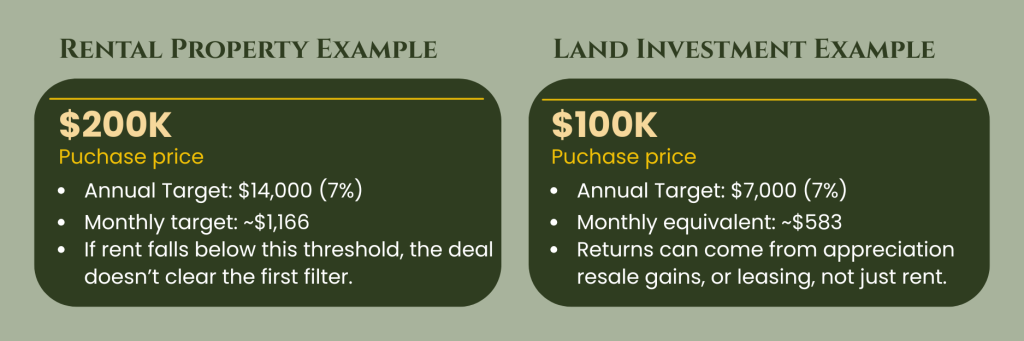
Practical Examples: How the 7% Rule Works
The 7% rule in real estate is simple math.
But it really clicks once you see it applied to real deals.
Think of it as a quick screening tool investors use before doing deeper analysis.
If a property passes the rule, it might be worth digging into the numbers.
If it fails, most investors move on fast and look for a stronger opportunity.
Here are two real-world scenarios:
Can a $400,000 Rental Property Actually Meet the 7% Rule?
Imagine an investor is evaluating a rental property priced at $400,000.
Using the 7% rule formula:
$400,000 × 0.07 = $28,000 annual income target
Now convert that annual income into a monthly rent requirement.
$28,000 ÷ 12 = $2,333 per month
So the property needs to generate about $2,333 in monthly rent to meet the 7% benchmark.
Now consider two possible outcomes.
If the property rents for $2,400 per month, the yearly income would be:
$2,400 × 12 = $28,800 per year
That exceeds the target. The deal passes the quick screening and may deserve deeper analysis such as operating costs, property taxes, and vacancy risk.
But if the property only rents for $1,600 per month, the yearly income would be:
$1,600 × 12 = $19,200 per year
That falls far below the $28,000 target.
At that point many investors walk away immediately.
And that’s exactly what the rule is designed to do.
It filters weak deals before you spend hours analyzing them.
When Raw Land Has No Rent: How the 7% Rule Still Applies
Raw land works differently from rental properties.
There’s usually no monthly income, so the return must come from future appreciation and resale value.
Let’s say an investor buys undeveloped land for $50,000.
Using the 7% rule:
$50,000 × 0.07 = $3,500 target annual return
If the investor plans to hold the property for five years, the expected growth becomes:
$3,500 × 5 = $17,500 total return
That means the land would ideally increase in value by $17,500 during that period.
So the target resale price becomes:
$50,000 + $17,500 = $67,500
If market conditions suggest the land could realistically sell for around $67,500 or more within five years, the investment may satisfy the 7% rule benchmark.
If the projected appreciation falls short of that number, the investor may decide the capital is better used elsewhere.
This is why many land investors treat undeveloped land as a long-term hold, waiting for development, population growth, or zoning changes to increase the property’s value.
Land vs. Traditional Real Estate: Applying the 7% Rule Differently
The 7% rule doesn’t change depending on property type, but how you reach that 7% does. Understanding this distinction is what separates disciplined investors from those who overpay for the wrong asset class.
| Factor | Traditional Real Estate | Land Investment |
|---|---|---|
| Primary Return Source | Monthly rental income from tenants | Long-term appreciation & resale gains |
| Cash Flow Timing | Immediate (if occupied) | Delayed, often years out |
| Management Burden | Property management, repairs, tenants | Minimal, especially raw land |
| Additional Income Options | Short-term rentals, multi-unit conversion | Leasing for agriculture, solar, recreation; subdividing lots |
| Entry Cost | Generally higher | Often lower, especially rural markets |
| Key Value Drivers | Location, condition, rental demand | Zoning flexibility, nearby development, access & terrain |
Strategic Tip for Land Investors
Land is often considered a long‑game investment.
Successful investors focus on three core drivers:
Strong location
Flexible zoning potential
Low carrying costs
Land investors may generate income through strategies such as:
Leasing land for agriculture or storage
Subdividing parcels
Adding improvements (utilities, access roads)
Holding for future resale
These strategies allow land investments to reach or exceed the 7% rule over time, even without rental income.
The "Other" 7% Rule in Real Estate
There’s another well‑known statistic in the industry:
Roughly 7% of real estate agents complete about 93% of all transactions.
While the exact percentages vary by market, the idea highlights a major truth about the industry—a small group of highly productive agents handles the majority of deals.
For property investors and homeowners looking to sell a house, working with experienced professionals can make a major difference.
However, there’s also an opportunity that many sellers overlook.
Some newer agents—those outside that top 7%—can still be incredibly valuable if they are:
Highly motivated
Well‑coached
Focused on building their reputation
These agents often provide:
Strong communication
Extra effort on marketing
High responsiveness to client needs
The key is identifying professionals who combine experience with genuine commitment to helping sellers succeed.
Limitations of the 7% Rule
While the 7% rule in real estate is extremely useful, it’s important to understand what it doesn’t account for.
It is a screening tool—not a final investment decision.
The rule does not include important factors such as:
Property taxes
Insurance costs
Maintenance and repairs
Vacancy periods
Financing costs
Property management fees
These expenses can significantly reduce the true return on an investment property.
However, the value of the 7% rule lies in speed and simplicity.
It helps investors quickly filter out weak deals before spending hours analyzing properties that ultimately won’t meet their financial goals.
Frequently Asked Questions About the 7% Rule in Real Estate
1. What should I do if land doesn’t hit the 7% rule right away?
Land investments often rely on long‑term appreciation rather than immediate cash flow. If the property is located in a growing area with strong development potential, it may still reach the 7% benchmark over several years through price appreciation alone.cc
2. Does the 7% rule apply to recreational land?ue?
What’s the difference between the 7% rule and the 1% rule?
3.0 What’s the difference between the 7% rule and the 1% rule?
The 1% rule focuses on monthly rent compared to purchase price, suggesting that rent should equal about 1% of the property value each month. The 7% rule measures annual return relative to purchase price and is often used as a broader investment screening metric.
4. Can owner‑financed land deals meet the 7% benchmark?Can owner‑financed land deals meet the 7% benchmark?
Yes. Many land investors sell properties using owner financing, collecting monthly payments from buyers. These payments can produce returns that meet—or even exceed—the 7% target depending on the terms of the financing agreement.
5. How can investors use the 7% rule in expensive markets like New York?
High‑price markets such as Queens and Long Island rarely meet the 7% rule through rent alone. Investors often rely more heavily on appreciation, redevelopment potential, or alternative strategies like short‑term rentals or property improvements.
Thinking About Selling Your House?
If you’ve been evaluating whether your property performs like a true investment—or simply carries high costs—it may be time to explore your options.
With over 14 years of experience, Sell My House in Queens by David Roy helps homeowners understand the real value of their property and explore the best path forward.
Sometimes the smartest move isn’t holding a property—it’s selling at the right time and reinvesting the equity more strategically.
Sign up for a free consultation today to review your options and see what your home could sell for in the current market.